I. From the Perspective of the Product Itself
(1) Specification Parameters
CV cables and XLPE cables offer a rich range of wire diameter options in terms of specification parameters, including 3.5mm², 5.5mm², 8mm², 14mm², 22mm², 30mm², 38mm², etc., which can meet the power transmission needs in different scenarios.
A 3.5mm² cable has a conductor cross-sectional area of 3.5 square millimeters. In terms of current-carrying capacity, it can usually carry a relatively small current and is generally suitable for low-power power transmission. For example, when connecting low-power electrical devices such as small table lamps and chargers in homes, a 3.5mm² cable can well meet the requirements. It has a relatively small outer diameter, is overall lightweight, and has high
Flexibility during wiring, making it suitable for installation in narrow spaces.
A 5.5mm² cable has a slightly larger cross-sectional area than a 3.5mm² one, and its current-carrying capacity has also increased accordingly. In addition to being used for some small household appliances with slightly higher power, such as TVs and microwave ovens, it can also be applied to the power connection of small office equipment, such as printers and copiers. Its physical size is slightly thicker than that of a 3.5mm² cable, but it still maintains good flexibility, facilitating bending and laying.
The current-carrying capacity of an 8mm² cable is further improved, which can meet the medium-power power transmission needs. In small industrial equipment, such as small machine tools and blowers, an 8mm² cable can stably provide power for them. At the same time, in the electrical lines of commercial stores, when connecting equipment such as air conditioners and freezers, this specification of cable is also a more appropriate choice. Its structure is relatively stronger and can withstand certain mechanical stress.
A 14mm² cable performs more excellently in terms of current-carrying capacity and is suitable for medium-power scenarios with high power demand. It can play an important role in some production line equipment of small processing plants and power supply in some areas of large shopping malls. Its wire core has stable conductivity and can continuously transmit a large current for a long time without easily overheating.
A 22mm² cable is a relatively large-diameter cable with a large current-carrying capacity, suitable for medium and high-power power transmission. Large industrial machinery, such as injection molding machines and large compressors, has a high demand for electricity, and a 22mm² cable can meet the power supply required for their normal operation. In the power supply lines of the main building structure, as part of the main line, this specification of cable can also ensure stable power transmission.
A 30mm² cable has a larger current-carrying capacity than a 22mm² one and is suitable for higher-power scenarios. In the main power supply lines of some large factories and the distribution systems of large buildings, a 30mm² cable can undertake the task of transmitting a large amount of electricity. Its insulation layer and sheath layer are specially designed to have better heat resistance and corrosion resistance, enabling it to adapt to relatively complex industrial environments.
A 38mm² cable is one of the larger specifications in this series, with the largest current-carrying capacity, mainly used in high-power power transmission scenarios. Municipal power main lines and some connection lines of large
Power Stations may use this specification of cable. Its overall structure is strong and durable, able to withstand the test of harsh environments, ensuring the safety and reliability of power transmission.
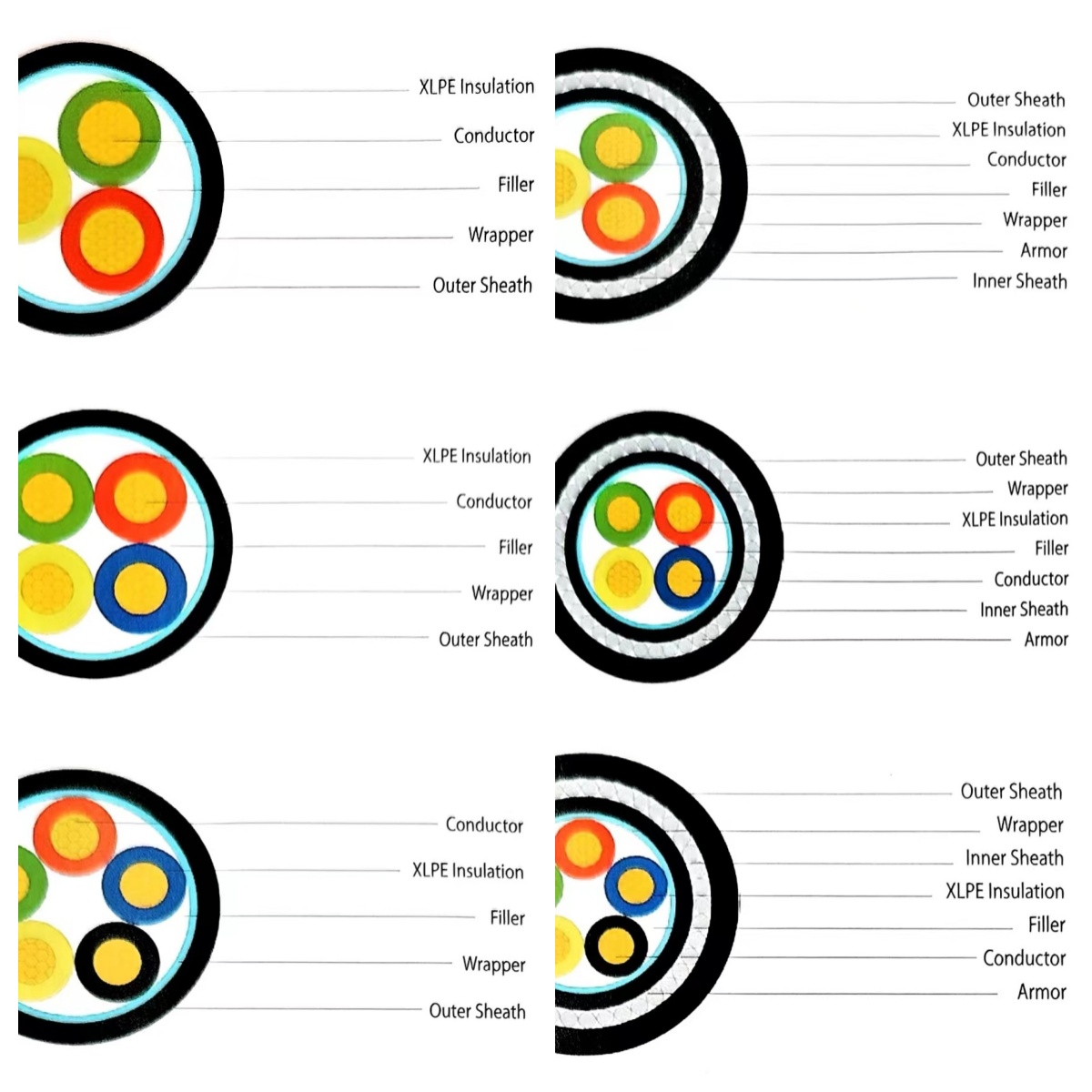
(2) Characteristic Uses
CV cables and XLPE cables have characteristic uses in different fields due to their respective performance characteristics.
For CV cables, their outstanding flexibility and corrosion resistance make them irreplaceable in some special environments. In humid environments, such as power wiring in underground parking lots, bathrooms, etc., CV cables can effectively resist the erosion of water vapor and ensure stable power transmission. In places with many chemical substances, such as some areas of chemical plants and laboratories, the corrosion resistance of CV cables can prevent chemical substances from damaging the cables and prolong their service life. In addition, in some scenarios that require frequent bending for wiring, such as the internal lines of large amusement facilities and the connection of moving parts of mechanical equipment, the flexibility of CV cables can meet their installation needs.
XLPE cables, with their excellent insulation performance, heat resistance and mechanical strength, perform well in high-temperature, high-voltage and other environments. In high-temperature environments, such as steelmaking workshops in metallurgical plants and around furnaces in glass factories, XLPE cables can maintain stable insulation performance at higher temperatures, ensuring the safety of power transmission. In some places with high insulation requirements, such as the power supply lines of precision instruments in hospitals and power transmission in data centers, the high insulation resistance of XLPE cables can effectively avoid current leakage, ensuring the normal operation of equipment and the safety of personnel. At the same time, in some scenarios that need to withstand large mechanical stress, such as
Overhead Lines and buried laying areas crushed by vehicles, the mechanical strength of XLPE cables can keep their structure intact and not easily damaged.
Both types of cables are commonly used in the connection between equipment and power sources in industrial power distribution systems to ensure that various production equipment can obtain the required power in a timely manner; in the strong and weak current wiring inside buildings, they provide power support for lighting, air conditioning, elevators and other facilities; in municipal engineering, street lamp power supply and underground pipeline power transmission are inseparable from the participation of these two types of cables. They provide stable and reliable power connections for various electrical equipment and facilities such as factory production lines, air conditioning systems in commercial buildings, and power supply networks in residential communities, ensuring the normal operation of social production and life.
(3) Material and Style
Material
There are certain differences in materials between CV cables and XLPE cables, which also determine their different performance characteristics.
The insulation layer of XLPE cables uses cross-linked polyethylene (XLPE) material. XLPE is obtained by cross-linking polyethylene, and its molecular structure forms a three-dimensional network structure, which gives XLPE many excellent properties. It has extremely high insulation resistance, which can effectively prevent current leakage, ensure the insulation performance of the cable, and thus improve the safety of power transmission. At the same time, XLPE has excellent heat resistance, able to maintain stable physical and chemical properties in higher temperature environments, and is not easy to age and damage. In addition, XLPE also has high mechanical strength, strong tensile and impact resistance, and can withstand certain external forces without breaking easily.
The material of CV cables is optimized in terms of flexibility and corrosion resistance. Its conductor usually uses high-purity copper or aluminum to ensure good conductivity. The insulation layer and sheath layer use special polymer materials, which have good flexibility, allowing the cable to be bent greatly without being damaged. At the same time, these materials also have excellent corrosion resistance, able to resist the erosion of water, acid, alkali and other chemical substances, protecting the internal conductor from damage.
Style
In terms of appearance style, both CV cables and XLPE cables have a variety of colors to choose from, commonly including black, gray, white, etc. Different colors are convenient for distinguishing and identifying during wiring, facilitating installation and maintenance.
In terms of structural style, both types of cables adopt a
Multi-Core structure, and the number of cores varies according to different specifications. The multi-core structure enables the cable to transmit currents of different phases or be used for different circuit connections at the same time, improving the use efficiency of the cable. In addition, the outer sheath of the cable usually adopts a smooth surface design, which not only facilitates laying and installation but also reduces the adhesion of dust and impurities, which is beneficial to keeping the cable clean.
Some CV cables and XLPE cables for special purposes also adopt an armored style, that is, adding a layer of metal armor layer, such as
Steel Tape or steel wire armor, on the outer layer of the cable. The armor layer can greatly improve the mechanical strength and external force resistance of the cable, making it suitable for more harsh environments, such as buried laying areas crushed by heavy vehicles and overhead lines.
(4) Production Process
The production processes of CV cables and XLPE cables are strictly controlled and optimized to ensure the quality and performance of the products.
Production Process of CV Cables
(1) Conductor Production: First, high-purity copper or aluminum raw materials are smelted and cast into copper rods or aluminum rods. Then, the copper rods or aluminum rods are drawn into wires of the required diameter through wire drawing equipment. During the wire drawing process, it is necessary to control the wire drawing speed and temperature to ensure the dimensional accuracy and mechanical properties of the wires.
(2) Insulation Layer Extrusion: After the produced conductor is cleaned and dried, it is sent to the extruder to extrude the
Insulation Material on the outer layer of the conductor. During the extrusion process, it is necessary to accurately control the temperature, pressure and speed of the extruder to ensure that the insulation layer has uniform thickness, smooth surface, and is tightly combined with the conductor.
(3) Cabling: For multi-core CV cables, it is necessary to strand multiple conductors wrapped with insulation layers according to a certain stranding method. During the stranding process, it is necessary to ensure that the positions of each core wire are uniform and the tension is consistent to ensure the structural stability of the cable.
(4) Sheath Extrusion: The sheath material is extruded on the outer layer of the cabled core. The selection of sheath material should be determined according to the service environment of the cable to ensure that it has good flexibility and corrosion resistance. During the extrusion process, it is also necessary to control the process parameters to ensure the quality of the sheath.
(5) Inspection: After production, a series of inspections are carried out on CV cables, including conductor resistance, insulation resistance, voltage resistance performance, mechanical performance, etc., to ensure that the products meet relevant standards and requirements.
Production Process of XLPE Cables
(1) Conductor Production: Similar to CV cables, the conductors of XLPE cables are also made of high-purity copper or aluminum through smelting, casting, wire drawing and other processes.
(2) Insulation Layer Extrusion and Cross-linking: After the conductor is cleaned and dried, the
XLPE Insulation Material is extruded in the extruder. After extrusion, the insulation layer needs to be cross-linked. Cross-linking is usually carried out by warm water cross-linking or steam cross-linking, placing the cable in an environment with a certain temperature and pressure to make the XLPE molecules undergo a cross-linking reaction to form a three-dimensional network structure. Cross-linking is a key link in the production process of XLPE cables, which directly affects the insulation performance and heat resistance of the cable.
(3) Cabling: For multi-
Core XLPE cables, multiple
Insulated Core wires are stranded into a cable according to design requirements, and filling materials are added in the middle of the cable core to ensure the roundness and stability of the cable.
(4) Sheath Extrusion: The sheath material is extruded on the outer layer of the cabled core. The sheath material should have good mechanical strength and environmental resistance. During the extrusion process, control the process parameters to ensure the quality of the sheath.
(5) Inspection: Strict inspections are carried out on XLPE cables, including insulation thickness, sheath thickness, cross-linking degree, conductor resistance, insulation resistance, voltage resistance performance, etc., to ensure that the product quality is qualified.
II. From the Perspective of General Product Information
(1) Packaging
The packaging of CV cables and XLPE cables follows certain standards and specifications to ensure that the cables are not damaged during transportation and storage.
For small-sized cables, reel packaging is usually adopted. The reel is generally made of cardboard or plastic, and the cable is neatly wound on the reel and then wrapped with a plastic film to prevent the intrusion of dust and moisture. The reel will be marked with the cable's model, specification, length, weight, manufacturer and other information for easy identification and management.
For large-sized cables, cable reel packaging is used. There are two types of cable reels: wooden and iron. Wooden cable reels have lower costs but relatively weaker load-bearing capacity; iron cable reels have strong load-bearing capacity and good durability, suitable for heavier cables. The size of the cable reel is designed according to the length and diameter of the cable to ensure that the cable can be tightly wound on it, avoiding looseness and distortion. After the cable is wound, a layer of linen or plastic cloth is wrapped on the outer layer of the cable to further protect the cable from external damage. At the same time, labels are fixed on the cable reel, indicating detailed information about the cable.
In addition, to prevent the cable from rolling during transportation, baffles are installed on both sides of the cable reel, and the height of the baffles is higher than the winding height of the cable. For some orders with special requirements, customized packaging can also be carried out according to customer needs, such as adding wooden frames and using anti-rust packaging materials.
(2) Transportation
The transportation of CV cables and XLPE cables needs to consider many factors to ensure the safety and integrity of the cables.
Transportation Methods: According to the distance of transportation and customer needs, different transportation methods can be selected. Short-distance transportation usually adopts road transportation, using trucks to load the cables and directly transport them to the destination. Road transportation has high flexibility and can deliver quickly. For long-distance transportation, railway transportation or waterway transportation can be chosen. Railway transportation has a large transport volume and good stability, suitable for transporting a large number of cables; waterway transportation has low cost, suitable for transporting large and heavy cables, but the transportation time is relatively long.
Transportation Precautions: During transportation, first of all, it is necessary to ensure that the loading of the cables is stable to avoid the cable reels from tilting, colliding and rolling during transportation. For wooden cable reels, attention should be paid to avoiding damage caused by excessive extrusion; for iron cable reels, anti-rust treatment should be done to avoid getting damp and rusting during transportation.
Secondly, cables should avoid direct sunlight and rain during transportation. Direct sunlight may cause aging of the cable's sheath layer, and rain may make the cable damp, affecting its insulation performance. Therefore, during transportation, it is necessary to cover the cables with waterproof cloth and other materials for protection.
In addition, when loading and unloading cables, professional hoisting equipment such as cranes and forklifts should be used to avoid damage to the cables caused by manual handling. When hoisting, appropriate lifting points should be selected to ensure that the cable reel is evenly stressed, avoiding deformation of the cable reel or falling of the cable from the reel.
Finally, traffic rules should be observed during transportation, and transportation routes and time should be reasonably arranged. Transportation in severe weather conditions should be avoided to ensure transportation safety.
(3) Delivery
The delivery process of CV cables and XLPE cables is rigorous and standardized to ensure that customers can receive qualified products in a timely manner.
Order Processing: After a customer places an order, the sales staff will promptly enter the order information into the system and transfer it to the production department or warehouse department. If the production department needs to arrange production, it will formulate a production plan according to the order requirements to ensure that production is completed on time; the warehouse department will check the inventory, and if there is stock, it will arrange delivery in a timely manner.
Product Inspection: Before delivery, the quality inspection department will conduct sampling inspections on the cables to check whether the appearance, size, performance, etc. of the cables meet the order requirements and relevant standards. Only products that pass the inspection can be arranged for delivery.
Packaging and Labeling: The inspected cables will be packaged in accordance with the specified packaging methods, and clear labels will be marked on the packaging, including customer name, order number, product model, specification, quantity and other information, so that customers can check when receiving the goods.
Logistics Arrangement: According to the customer's address and transportation requirements, a suitable logistics company is selected, and a transportation contract is signed with the logistics company to clarify the responsibilities and obligations of both parties. The logistics company will arrange vehicles to pick up the goods at the factory or warehouse. When picking up the goods, the staff will check the product information and quantity with the logistics company, and go through the handover procedures after confirming that they are correct.
Delivery Notification: After the cables are shipped, the sales staff will promptly notify the customer of the delivery information, including the logistics company name, transportation order number, estimated arrival time, etc., to facilitate the customer to track the transportation status of the goods.
(4) Samples
To allow customers to better understand the performance and quality of CV cables and XLPE cables, the enterprise provides sample services.
Sample Application: Customers can apply for samples from the enterprise by phone, email, online platform, etc., indicating the model, specification, quantity and other information of the required samples. The enterprise's sales staff will promptly respond to the customer's application and confirm the relevant details of the samples.
Sample Preparation: After receiving the sample application, the production department or sample preparation workshop will prepare samples according to the customer's requirements. The production process of the samples is consistent with that of the formal products to ensure that the samples can truly reflect the performance and quality of the products. During the preparation process, strict quality control will be carried out on the samples to ensure that they meet relevant standards.
Sample Delivery: After the samples are prepared, they will be packaged and labeled, and then sent to the customer by express or logistics. Before sending, the express order number and other information of the samples will be informed to the customer to facilitate the customer to check the delivery status of the samples.
Sample Fees: The cost of samples is usually borne by the customer, including the production cost and transportation cost of the samples. If the customer subsequently signs a bulk order, the enterprise can reduce or refund the sample fee according to the order amount and sample fee situation. The specific sample fees and policies can be negotiated with the sales staff.
(5) After-sales Service
The enterprise provides perfect after-sales service for CV cables and XLPE cables to solve problems encountered by customers during use.
Quality Assurance: The enterprise provides a certain period of quality assurance for the produced CV cables and XLPE cables, usually 1-3 years. During the quality assurance period, if the cable has quality problems caused by non-human factors, such as aging of the insulation layer and conductor breakage, the enterprise will provide free repair or replacement services for the customer.
Technical Support: Customers can contact the enterprise's technical support department at any time if they encounter any technical problems during the installation, use and maintenance of the cables. Technical personnel will provide professional technical guidance to customers through phone calls, emails, videos, etc., answer customers' questions and help them solve problems.
Fault Handling: If the cable fails during use, customers can report the fault to the enterprise's after-sales service department. After-sales service personnel will respond promptly, understand the fault situation, and arrange professional maintenance personnel to go to the site for handling. Maintenance personnel will inspect and diagnose the faulty cable, determine the cause of the fault, and take corresponding maintenance measures to restore the normal operation of the cable as soon as possible.
Customer Feedback: The enterprise attaches great importance to customers' feedback and has set up special customer feedback channels, such as suggestion boxes and complaint hotlines. Customers can put forward opinions and suggestions on product quality, service attitude, etc. The enterprise will promptly handle and improve the problems reflected by customers, continuously improving product quality and service level.
Return and Exchange Policy: If the received cable has quality problems or does not meet the order requirements, customers can apply for return or exchange within 7 days after receiving the goods. The enterprise will review the application, and if the situation is true, it will handle the return or exchange procedures for the customer and bear the corresponding transportation costs. For returns and exchanges due to non-quality problems, customers need to bear the round-trip transportation costs, and the cable must be kept intact without affecting secondary sales.


 English
 Español
 Portugues
 Pусский
 Français
 العربية
 Türk dili
 Indonesia
 Tiếng Việt



 โทรศัพท์
 จดหมาย