Detailed Introduction to U1000 R2V Cables (1240mm², 1300mm², 1400mm², 1500mm²)
I. From the Perspective of the Product Itself
(I) Specification Parameters
The specification parameters of U1000
R2V Cables are meticulously designed to meet diverse power transmission requirements in
Power Station scenarios, with each parameter having clear standards and practical application significance.
The rated voltage is 1000V, which is determined based on the common voltage levels of medium and low-voltage distribution networks in power stations. It can stably adapt to the voltage requirements of various equipment inside the power station, ensuring voltage stability during power transmission and avoiding equipment failures or power losses caused by voltage mismatch.
This series of cables covers various cross-sectional area specifications such as 1240mm², 1300mm², 1400mm², and 1500mm². Different cross-sectional areas correspond to different current-carrying capacities, forming a gradient specification system. The 1240mm² cable, when laid in the air with better heat dissipation conditions, has a current-carrying capacity of approximately 420A; when laid underground with relatively poor heat dissipation, the current-carrying capacity is about 350A. The 1300mm² cable has a current-carrying capacity of 480A in the air and about 400A underground, which can carry a larger current than the 1240mm² cable and is suitable for equipment with slightly higher power. The 1400mm² cable has a current-carrying capacity of 550A in the air and 460A underground, further enhancing the current-carrying capacity and can be used to connect high-power power station equipment. The 1*500mm² cable has a current-carrying capacity of 630A in the air and 530A underground, which is the largest in this series and can meet the needs of large-capacity power transmission.
This gradient specification design has important practical significance. In power stations, from the power supply of auxiliary equipment such as lighting and small control instruments to large-capacity power transmission such as main transformer outgoing lines, different equipment and lines have significant differences in current demand. By providing cables with multiple cross-sectional area specifications, it can flexibly adapt to the power connection of different equipment such as boilers, steam turbines, and generator sets, ensuring that each power transmission point is supported by the most suitable cable. This not only avoids cost waste due to excessively large cable specifications but also prevents failure to meet current-carrying requirements due to excessively small specifications.
In addition, the outer diameter of the cable increases accordingly with the increase of the cross-sectional area. The outer diameter of the 1240mm² cable is approximately 25-30mm, the 1300mm² cable is about 28-33mm, the 1400mm² cable is around 32-37mm, and the 1500mm² cable is about 36-41mm. The change in outer diameter matches the cross-sectional area, which not only ensures the reasonable layout of internal structures such as conductors and insulation layers of the cable but also adapts to different laying spaces and pipe sizes in the power station, facilitating installation and laying in cable trenches, cable trays, and other places.
The bending radius of the cable is not less than 12 times the outer diameter. This parameter ensures that the cable can be properly bent in the complex wiring environment of the power station without damaging the
Structure and Performance of the cable. Whether turning in narrow spaces or bypassing equipment, it can meet the bending requirements, improving the installation
Flexibility of the cable in power station scenarios.
(II) Characteristic Applications
The characteristic applications of
U1000 R2V Cables are closely centered on the full-scene power transmission of the power station. With their diverse specifications and excellent performance, they play a key role in different areas and equipment connections of the power station.
In the power generation plant, cables of different cross-sectional areas have clear application divisions. Due to its maximum current-carrying capacity, the 1500mm² cable can be used as the connecting cable from the main transformer to the high-voltage switchgear, undertaking the important task of large-capacity power output. The main transformer is one of the core equipment of the power station, which boosts the low-voltage electricity generated by the generator and transmits it to the high-voltage power grid. The 1500mm² cable can stably transmit high-voltage electricity from the main transformer to the high-voltage switchgear, laying the foundation for subsequent power distribution.
The 1400mm² cable is suitable for the transmission line between the generator set and the step-up station. The electricity generated by the generator set needs to be transmitted to the step-up station for voltage boosting. The power transmission volume in this process is relatively large, and the current-carrying capacity of the 1400mm² cable can meet this demand, ensuring that electricity is efficiently and stably transmitted from the generator set to the step-up station.
The 1
300mm² cable is often used as the Power Cable for large auxiliary machines such as boilers and water pumps. The boiler is a key equipment for generating steam in the power station, and the water pump is responsible for providing water sources for various systems. These large auxiliary machines have high power and high power demand. The 1300mm² cable can provide stable power support for them, ensuring the normal operation of the auxiliary machines.
The 1240mm² cable is suitable for low-voltage auxiliary circuits such as lighting and control systems. In the power station, the lighting system ensures the brightness of the plant and equipment areas, and the control system accurately regulates various equipment. The voltage and current of these circuits are relatively low. The 1240mm² cable can meet their power transmission needs, and its cost is relatively low, with high economy.
In the outdoor distribution area of the power station, this series of cables also performs well. The outdoor environmental conditions are relatively complex, facing problems such as soil corrosion and large temperature differences. U1000 R2V cables can be laid underground or through pipes. Their outer sheath materials have good corrosion resistance and weather resistance, which can withstand the corrosion of chemical substances in the soil and the temperature changes in the outdoor environment, ensuring stable and reliable power distribution from the step-up station to each node in the plant area.
At the same time, its single-core structure design has obvious advantages in power station scenarios. The layout of cable trenches and cable trays in the power station is usually dense with limited space. The single-
Core Cable has good flexibility, which is convenient for laying and installation in narrow spaces, can adapt to complex wiring environments, and reduces difficulties and obstacles in the installation process.
In addition, U1000 R2V cables can also play an important role in the
Emergency Power Supply system of the power station. When the main power supply system fails, emergency power supply equipment needs to be put into operation quickly. This series of cables can quickly establish a temporary power transmission channel, provide power support for key equipment, and ensure the safe and stable operation of the power station.
(III) Material and Style
Material
The conductor is made of high-purity electrolytic copper with a purity of ≥99.95%. High-purity electrolytic copper has extremely excellent conductivity because the higher the purity, the fewer impurities in the copper. Impurities will affect the conduction of current, increasing resistance and energy loss. In power station scenarios, where power transmission is large, the requirements for conductivity are extremely high. High-purity electrolytic copper can ensure the smooth flow of current during transmission, minimize energy loss, and improve power transmission efficiency.
At the same time, high-purity electrolytic copper has good ductility and plasticity. After being formed by the bunch stranding process, the structure of the conductor is more stable, and the resistance to mechanical vibration is significantly enhanced. Equipment in the power station, such as steam turbines and generators, will generate high-frequency vibration during operation. The stranded
Copper Conductor can effectively cope with this vibration environment, avoid conductor breakage or poor contact caused by long-term vibration, and ensure the continuity and stability of power transmission. At 20℃, the DC resistance of the conductor is ≤0.0741Ω/km, which further proves its excellent conductivity.
The insulation layer is made of cross-linked polyethylene (XLPE) material, treated by the peroxide cross-linking process. This process makes XLPE molecules form a three-dimensional network structure, greatly improving the performance of the material. The temperature resistance range of the XLPE insulation layer is -40℃ to 90℃. In case of short-term overload, it can withstand high temperatures of 130℃, and can adapt to temperature changes generated during the operation of equipment in the power station and extreme temperature conditions in the outdoor environment.
In addition, the XLPE insulation layer has an extremely high insulation resistance of ≥1000MΩ·km, which can effectively prevent current leakage, ensure insulation stability under high voltage, and avoid safety accidents such as short circuits. Its dielectric loss tangent value is ≤0.003 (at 20℃), which means that the energy loss caused by the insulation layer during power transmission is extremely small, improving the overall power transmission efficiency.
The outer sheath of the cable is mostly made of weather-resistant polyvinyl chloride (PVC) or halogen-free low-smoke flame-retardant materials. Weather-resistant PVC materials have good UV resistance, can be used outdoors for a long time without aging, cracking, etc.; at the same time, they also have certain chemical corrosion resistance, and can resist the erosion of acids, alkalis, and other substances in the soil. Halogen-free low-smoke flame-retardant materials are more prominent in terms of safety. In case of fire, they will not release toxic and harmful gases, and produce less smoke, which is conducive to personnel evacuation and equipment protection, and is especially suitable for power stations with high safety requirements.
Style
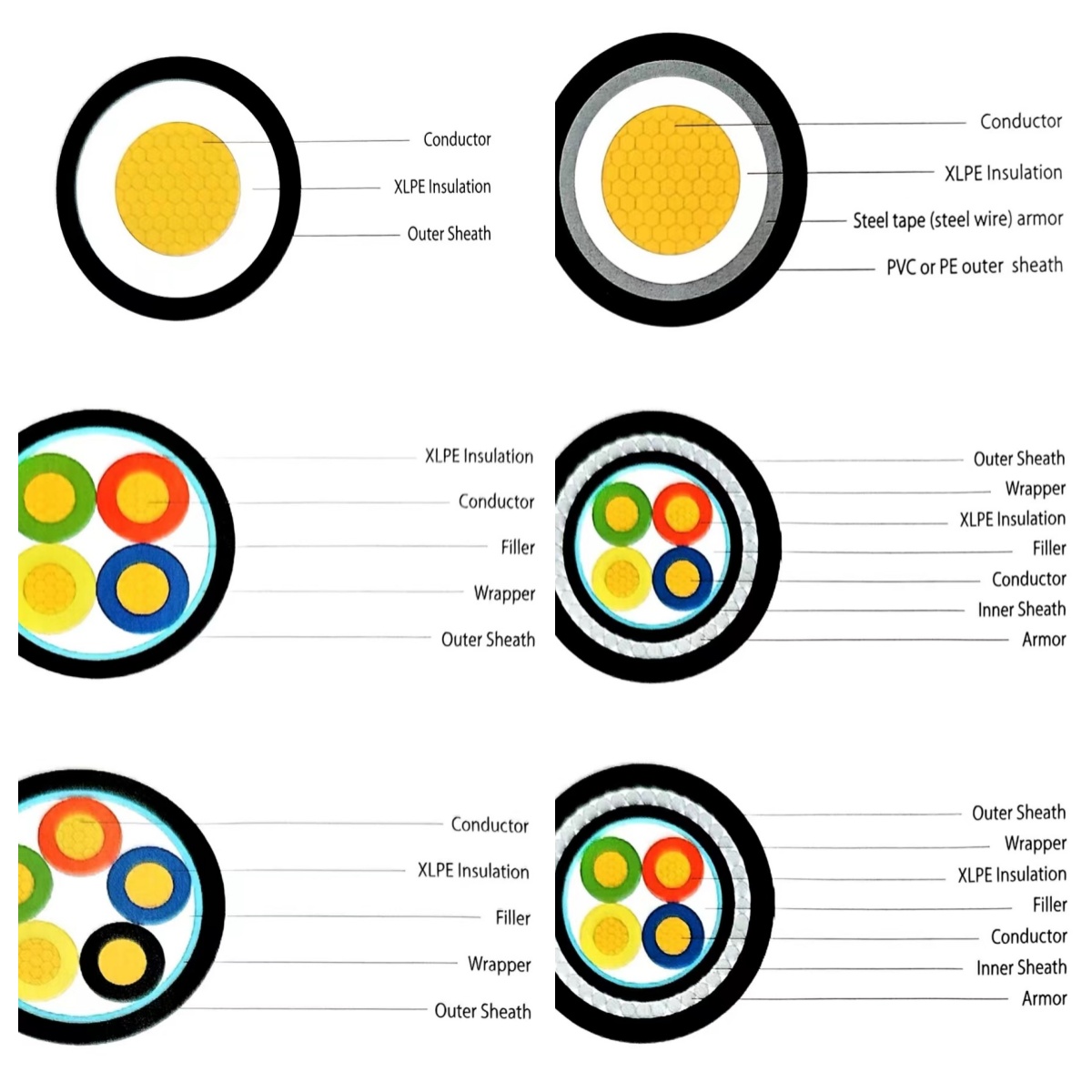
In terms of appearance, the outer sheath of U1000 R2V cables is usually black or gray. Black and gray are neutral colors, not easily affected by stains, and can maintain good appearance cleanliness in the complex environment of the power station. At the same time, these two colors are also convenient to distinguish from other equipment and pipelines in the power station, reducing misoperation during installation and maintenance.
In terms of structural style, the cable adopts a single-core structure, consisting of a composite structure of "conductor-insulation layer-shielding layer-sheath layer". This structure has distinct layers, and each layer has a specific function. The conductor, as the core of power transmission, is located in the innermost layer; the insulation layer tightly wraps around the conductor to provide electrical insulation protection; the shielding layer is made of semi-conductive material and wraps around the insulation layer, whose main function is to evenly distribute the electric field, avoid insulation breakdown caused by excessive local electric field strength, and ensure the insulation performance and safe operation of the cable; the outermost sheath layer provides mechanical protection and environmental isolation, preventing the internal structure of the cable from external physical damage and environmental erosion.
The thickness of the sheath layer varies according to the cable specifications, generally between 2.0-3.0mm. Cables with larger cross-sectional areas have relatively thicker sheath layers to provide stronger mechanical protection and adapt to greater external pressure and tension.
In addition, according to different application scenarios and customer needs, styles with special properties can also be provided. For example, for areas with high fire protection requirements, cables with halogen-free low-smoke flame-retardant sheaths can be provided; for situations that need to be used in highly corrosive environments, cables with enhanced corrosion-resistant sheaths can be provided to further improve the adaptability and service life of the cables.
(IV) Production Process
The production process of U1000 R2V cables is complex and rigorous, with each link undergoing strict control and inspection to ensure that the quality and performance of the products meet the high standards required in power station scenarios.
Conductor Manufacturing
First, high-purity electrolytic copper ingots are selected as raw materials and put into a melting furnace for melting. During the melting process, the temperature needs to be accurately controlled to ensure that the copper ingots are completely melted. At the same time, degassing and slag removal treatments are carried out to remove gases and impurities in the copper water, ensuring the purity of the copper. Then, the molten copper water is cast into copper rods through a continuous casting machine, and the diameter of the copper rods is adjusted according to the specifications of the final conductor.
Next, the copper rod is drawn. The copper rod is drawn into fine
Copper Wires through a series of wire drawing dies with different apertures. During the drawing process, the copper wire will produce work hardening due to plastic deformation, so annealing treatment is required. Annealing is usually carried out in a continuous annealing furnace, heating the copper wire to a specific temperature (generally 300-500℃) and keeping it for a certain time to eliminate the internal stress of the copper wire and restore its flexibility and conductivity.
Finally, multiple annealed copper wires are stranded using the bunch stranding process to form conductors with the required cross-sectional area. The bunch stranding process can make the copper wires closely combine, increase the overall strength and flexibility of the conductor, and ensure the uniform and stable conductivity of the conductor. During the stranding process, the stranding pitch and tension need to be strictly controlled to ensure the structural stability of the conductor and meet the requirements of resistance to mechanical vibration.
Insulation Layer Extrusion
The insulation layer is made of XLPE material and wrapped around the conductor through an extrusion process. First, XLPE particles are uniformly mixed with necessary additives (such as cross-linking agents, antioxidants, etc.) and then added to the extruder. In the extruder, the material is heated to a molten state (temperature is about 120-150℃), and the molten XLPE material is pushed into the mold through the rotation of the screw.
The shape and size of the mold are accurately designed according to the specifications of the cable to ensure that the XLPE material can be evenly extruded and wrapped on the surface of the conductor to form an insulation layer with uniform thickness. During the extrusion process, it is necessary to strictly control the extrusion temperature, speed, and pressure to ensure the quality of the insulation layer and avoid defects such as bubbles, impurities, and uneven thickness.
After extrusion, the insulation layer is subjected to peroxide cross-linking treatment. The cable is placed in a cross-linking tube, and in a high-temperature and high-pressure environment (usually the temperature is 180-200℃ and the pressure is 0.5-1.0MPa), the peroxide in the XLPE material decomposes to generate free radicals, triggering cross-linking reactions between molecules to form a three-dimensional network structure. Cross-linking treatment can significantly improve the temperature resistance, mechanical strength, and insulation performance of XLPE materials, which is a key process to ensure the quality of the insulation layer.
Shielding Layer and Sheath Layer Processing
A shielding layer needs to be wrapped around the insulation layer. The shielding layer is made of semi-conductive material, usually semi-conductive polyethylene. The semi-conductive material is heated and melted, and then evenly extruded and wrapped on the surface of the insulation layer through an extrusion process. The thickness of the shielding layer needs to be strictly controlled to ensure that it can effectively evenly distribute the electric field.
After the processing of the shielding layer, the sheath layer is extruded. According to the design requirements, weather-resistant PVC or halogen-free low-smoke flame-retardant materials are selected as the sheath material. The sheath material is added to the extruder, heated and melted, and then extruded and wrapped on the outside of the shielding layer through a mold to form the sheath layer. During the extrusion process, it is necessary to ensure that the sheath layer is closely combined with the shielding layer, with uniform thickness, smooth surface, and no cracks, bubbles, or other defects. The thickness of the sheath layer depends on the cable specifications to provide sufficient mechanical protection.
Inspection and Marking
The finished cables need to undergo a series of strict inspections, including the detection of conductor DC resistance, insulation resistance, voltage resistance performance, sheath thickness, outer diameter size, and other items. These testing items are carried out in accordance with relevant national standards and industry standards to ensure that each batch of cables meets the quality requirements.
Qualified cables will be printed with marks. The surface of the sheath layer is printed with information such as the cable's model, specification, rated voltage, manufacturer, production date, etc. The marks are made of wear-resistant and weather-resistant ink to ensure that they are clearly visible during the service life of the cable, facilitating identification and traceability.
Winding and Packaging
Finally, the qualified cables are wound according to the specified length, usually using large reels for winding. The material and size of the reel are selected according to the specifications and length of the cable to ensure that the cable is not damaged during storage and transportation. During the winding process, the tension should be controlled to make the cable arranged neatly and avoid looseness or distortion.
II. From the Perspective of General Product Information
(I) Packaging
The packaging design of U1000 R2V cables fully considers the characteristics of the product and the needs of transportation and storage, aiming to provide reliable protection for the cables and ensure that the products remain in good quality when they arrive at the power station site.
For coiled cables, wooden reels are usually used for packaging. Wooden reels have high strength and stability and can withstand the weight of the cable and the external force generated during transportation and handling. The diameter and width of the reel are determined according to the specifications and length of the cable. For cables with smaller cross-sectional areas such as 1240mm² and 1300mm², the reel diameter is relatively small; for cables with larger cross-sectional areas such as 1400mm² and 1500mm², the reel diameter is larger to adapt to longer cable lengths and greater weights.
Metal flanges are installed on both sides of the reel, and evenly distributed holes are arranged on the flanges for fixing the cable reel during transportation and storage to prevent the reel from rolling or tipping over. The thickness and strength of the metal flanges are strictly calculated to ensure they can bear the total weight of the reel and cable.
When the cable is wound onto the reel, appropriate tension is maintained to ensure the cable is arranged neatly and tightly, avoiding looseness, crossing, or knotting. This not only saves storage space but also prevents damage to the insulation layer or sheath layer caused by mutual friction of the cable during transportation.
To protect the cable from dust, moisture, and direct sunlight, a layer of plastic film is wrapped around the cable surface. The plastic film has good moisture-proof performance, which can prevent moisture in the air from entering the interior of the cable and affecting the insulation performance; at the same time, it can also prevent dust from adhering to the cable surface, keeping the cable clean. For cables that need to be stored for a long time or transported in harsh environments, a layer of waterproof canvas is covered outside the plastic film to further enhance the ability of waterproofing, sun protection, and anti-collision.
In a prominent position of the packaging, product labels are pasted or printed, which clearly indicate the cable's model, specification (such as 1*240mm²), length, rated voltage, production batch number, production date, execution standard, manufacturer's name, address, contact information, and other information. This information helps users quickly identify and check when receiving and accepting products, ensuring that the received products meet the order requirements.
For small batches or short-length cables, high-strength cartons may be used for packaging. Foam or partitions are placed inside the cartons to fix the cables, avoiding shaking and collision of the cables during transportation. The surface of the cartons is also printed with relevant product information and warning signs, such as "Do Not Stack Heavily" and "Keep Dry and Avoid Sunlight".
(II) Transportation
The transportation process of U1000 R2V cables needs to strictly abide by relevant regulations and operating procedures to ensure the safety and quality of the cables during transportation and smoothly reach the power station destination.
Before transportation, a comprehensive inspection of the cable packaging is required to confirm that the reel is firm, the packaging is intact, and the labels are clear and complete. For cables packaged with wooden reels, check the integrity of the reel, the fixing of the metal flanges, and whether the cable is wound neatly. If the packaging is damaged or loose, repair and reinforce it in time to avoid problems during transportation.
The choice of transport vehicles depends on the quantity, specifications, and transport distance of the cables. Ordinary trucks can be used for short-distance transportation, while large trucks or container transportation are suitable for long-distance transportation. Container transportation has the advantages of good sealing, rainproof, sunproof, and anti-theft, which can provide a more stable transportation environment for cables, especially suitable for long-distance transportation or cross-regional transportation.
When loading cables, use professional equipment such as forklifts and cranes for operation to avoid damage caused by manual handling. Arrange the cable reels neatly in the carriage of the transport vehicle, leaving a certain gap between the reels to prevent mutual extrusion. For large reels, fix them firmly on the carriage with steel wire ropes or fastening belts, and the fixing points should be selected at the metal flanges of the reels to ensure that the reels do not move, roll, or tip over during transportation.
During transportation, it is necessary to pay attention to avoiding extreme weather conditions. In rainy or snowy weather, ensure that the transport vehicle or container is well sealed to prevent rainwater or snow from entering and damaging the cables. In high-temperature weather, take shading measures for the cables to avoid long-term exposure to the sun, which may cause aging of the cable sheath and insulation layer due to high temperature.
The driver should abide by traffic rules during transportation, maintain a reasonable speed, and avoid sudden braking, sharp turns, and other operations to reduce the impact on the cables. During long-distance transportation, regular stops should be made to check the fixing of the cables. If any looseness or displacement is found, re-fix them in time to ensure the stability of the cables.
For cross-border transportation or long-distance transportation involving multiple regions, it is necessary to understand the relevant transportation regulations and customs policies of the passing regions in advance, prepare complete transportation documents, such as waybills, invoices, packing lists, and product certification documents, to ensure smooth customs clearance and transportation.
After arriving at the destination, unloading operations should be carried out by professional personnel using appropriate equipment. During unloading, avoid violent collision and dropping of the cable reels to prevent damage to the cables and reels. After unloading, check the cables together with the receiving party of the power station, and confirm that the packaging is intact, the labels are clear, and the quantity and specifications are consistent with the order, then sign for acceptance.
(III) Shipment
The shipment process of U1000 R2V cables is an important link to ensure that customers receive products on time, which is organized and implemented in an orderly manner through strict procedures.
After the customer places an order, the sales department will timely transmit the order information to the warehouse department, including the product model, specification, quantity, delivery address, and delivery time. The warehouse department will check the inventory according to the order requirements. If the inventory is sufficient, arrange the goods preparation work; if the inventory is insufficient, timely feedback to the production department and sales department, and the production department will arrange production as soon as possible to ensure that the goods are prepared within the agreed delivery time.
After the goods are prepared, the warehouse department will conduct a detailed inspection of the cables, including checking the appearance of the cables, the integrity of the packaging, and the consistency of the labels with the order information. After passing the inspection, the goods are transferred to the logistics department, and a detailed shipment list is provided, which includes the product name, model, specification, quantity, weight, volume, and other information to facilitate the logistics department's arrangement of transportation.
The logistics department will choose a suitable logistics company according to the delivery address and customer requirements, and sign a transportation contract with it, clarifying the rights and obligations of both parties, such as transportation time, transportation safety, and liability for loss or damage. At the same time, in order to reduce the risk of transportation, it is recommended to purchase freight insurance for the cables, so that in case of loss, damage, or other accidents during transportation, corresponding compensation can be obtained to reduce economic losses.
Before shipment, the logistics department will notify the customer of the shipment information in advance, including the name of the logistics company, waybill number, estimated arrival time, and contact information of the driver, so that the customer can make preparations for receiving the goods. At the same time, the logistics department will track the transportation status of the goods in real time, and promptly feedback the transportation progress to the customer and the manufacturer.
If there is a delay in transportation due to force majeure or other reasons, the logistics department should timely communicate with the customer and the manufacturer, explain the reasons, and put forward solutions. After the goods arrive at the destination, the logistics department will assist the customer in completing the acceptance procedures and handle the problem of goods damage or inconsistency in a timely manner.
(IV) Samples
To help customers better understand the performance and quality of U1000 R2V cables before purchasing in large quantities, the manufacturer provides sample services to facilitate customers' testing and evaluation.
Customers can apply for samples through the manufacturer's official website, phone calls, emails, and other channels, specifying the required cable model, specification, quantity, and other information, as well as their own contact information and delivery address. After receiving the sample application, the manufacturer's sales staff will contact the customer within 1-3 working days to confirm the sample requirements, and inform the customer of the sample related matters, such as whether the sample is free, the cost of sample transportation, and the estimated delivery time.
For general specifications of samples, the manufacturer usually provides them free of charge, but the customer needs to bear the transportation cost. The transportation method of the sample can be chosen by the customer, such as express delivery or ordinary mail. The manufacturer will pack the sample properly, and attach a sample test report, which includes the test data of the sample's conductor resistance, insulation resistance, voltage resistance performance, and other parameters, to help customers better understand the sample performance.
After the customer receives the sample, they can conduct relevant tests according to their own needs, such as testing the flexibility, wear resistance, and high-temperature resistance of the cable. If the customer has any questions about the sample or needs technical support during the test, the manufacturer's technical staff will provide timely answers and guidance.
If the customer is satisfied with the sample, they can place a formal order; if there are opinions or suggestions on the sample, the manufacturer will communicate with the customer in a timely manner and make corresponding improvements according to the customer's needs to meet the customer's requirements.
(V) After-sales Service
The manufacturer of U1000 R2V cables attaches great importance to after-sales service and has established a complete after-sales service system to provide customers with comprehensive and thoughtful support.
Quality Assurance
The manufacturer guarantees that U1000 R2V cables meet the relevant national standards and industry standards, and provides a quality guarantee period of 18-24 months from the date of delivery. During the guarantee period, if the cable has quality problems such as insulation breakdown, conductor damage, or sheath cracking due to manufacturing defects, the manufacturer will provide free repair, replacement, or return services according to the actual situation.
To apply for after-sales service, customers need to provide relevant documents such as the purchase contract, invoice, and product quality problem description. The manufacturer's after-sales staff will verify the problem within 2-3 working days after receiving the application. If it is confirmed to be a product quality problem, they will formulate a solution and implement it as soon as possible to minimize the impact on the customer's use.
Technical Support
The manufacturer has a professional technical support team composed of experienced electrical engineers who can provide customers with technical guidance and solutions related to cable selection, installation, and maintenance. Customers can consult the technical support team through phone calls, emails, or on-site visits.
For example, during the cable installation process, if customers encounter problems such as how to correctly connect the cable, how to choose the laying method, or how to test the cable performance, the technical support team will provide detailed guidance and suggestions based on the actual situation of the power station. In addition, the manufacturer can also provide technical training for customers' staff, including cable knowledge, installation skills, and maintenance methods, to improve the customer's ability to use and manage cables.
Complaint Handling
If customers have complaints about product quality, service attitude, or other aspects, they can feedback to the manufacturer's after-sales department through the official complaint channel. The after-sales department will record the complaint content and contact the customer within 24 hours to understand the specific situation in detail.
The after-sales department will conduct an investigation and analysis of the complaint, and give a clear reply to the customer within 5-7 working days, including the cause of the problem, the handling method, and the time limit for processing. If the complaint is caused by the manufacturer's responsibility, the manufacturer will take the initiative to assume the corresponding responsibility and apologize to the customer; if it is caused by improper use by the customer, the manufacturer will provide guidance and help to solve the problem.
Regular Follow-up
After the cable is put into use, the manufacturer will conduct regular follow-up visits to customers to understand the use of the cable, collect customer opinions and suggestions, and provide relevant maintenance advice. The follow-up methods include phone calls, emails, or on-site visits. For key customers or large power station projects, the manufacturer will arrange technical personnel to conduct on-site inspections regularly to check the operation status of the cables and deal with potential problems in time.
Through regular follow-up, the manufacturer can better understand the actual use of the products, continuously improve product quality and service levels, and maintain long-term and stable cooperative relations with customers.
In summary, U1000 R2V cables, with their excellent performance, diverse specifications, and comprehensive services, provide a reliable power transmission solution for power stations. From product design and production to packaging, transportation, shipment, sample provision, and after-sales service, every link reflects the manufacturer's pursuit of quality and responsibility to customers, making it an ideal choice for power station power transmission.


 English
 Español
 Portugues
 Pусский
 Français
 العربية
 Türk dili
 Indonesia
 Tiếng Việt



 โทรศัพท์
 จดหมาย