
 English
 Español
 Portugues
 Pусский
 Français
 العربية
 Türk dili
 Indonesia
 Tiếng Việt


Control Cable Wire
ค้นหา {คีย์เวิร์ด} การขายส่ง & คำพูดจากประเทศจีน เราเป็นผู้ผลิตมืออาชีพของ บริษัท {คีย์เวิร์ด} โรงงานและผู้ส่งออกเชี่ยวชาญใน {คำหลัก} ที่มีคุณภาพสูง
สินค้า
การจัดหมวดหมู่:
-
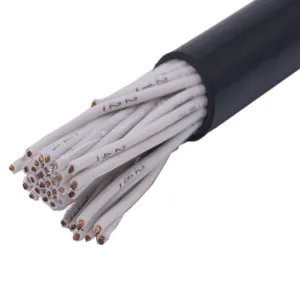
24-Core & 12-Core Control Cable Combo, 1.5mm² Flexible Copper Wire PVC Sheathed for PLC, Sensor, Electro-Mechanical Wiring
การจัดหมวดหมู่: สายเคเบิลควบคุมเข้าชม: 347จำนวน:เวลาเผยแพร่: 2025-08-27 02:57:10This product is a 24-core and 12-core control cable combo, a core signal and command transmission equipment specially designed for industrial automation scenarios. Each core has a uniform conductor cross-section of 1.5mm², made of flexible copper wire with a PVC sheath. It is precisely adapted to the wiring needs of PLC (Programmable Logic Controller), sensors, and various electromechanical equipment. Through the flexible configuration of "multi-core combination", it can not only meet the needs of parallel transmission of a large number of signals in complex systems but also adapt to the simplified wiring scenarios of small and medium-sized equipment. It provides a stable, efficient, and low-cost wiring solution for industrial production lines, intelligent control cabinets, automated machine tools, and other scenarios. In terms of core specifications and structural design, the cable is provided as a "combination set" with two core count options: 24-core and 12-core. The cross-section of each core conductor of both specifications is 1.5mm². This parameter is calculated based on the signal transmission needs of industrial automation scenarios. The 1.5mm² flexible copper wire can not only ensure sufficient current-carrying capacity (meeting the low current demand for control signal transmission while avoiding signal attenuation caused by overly thin conductors) but also transmit multiple groups of control signals in a single cable through the "multi-core integration" design. This significantly reduces the number of wires, lowering the wiring complexity inside control cabinets or between equipment. The 24-core specification is suitable for signal-intensive scenarios, such as the connection between large PLC control systems and multiple sensors/actuators (e.g., the main control PLC of an automobile production line needs to receive signals from dozens of position sensors and pressure sensors simultaneously and send action commands to multiple robotic arms). The 12-core specification is adapted to small and medium-sized wiring needs, such as the connection between the local control unit of a single automated machine tool and surrounding equipment (e.g., the signal interaction between the control panel of a CNC machine tool and the spindle motor, cooling system). The combination of the two specifications can flexibly meet the wiring differences of automation systems of different scales, reducing the cost and inventory pressure caused by users purchasing cables of different core counts separately. The flexible copper wire conductor is the core material advantage of this cable. Compared with rigid conductors or thin-gauge copper wires, it has three core values: First, excellent flexibility. The conductor is made of multiple strands of fine copper wire through a stranding process, which can be bent with a small radius in narrow spaces (the minimum bending radius is usually 6-8 times the cable outer diameter). It is suitable for the dense terminal layout inside control cabinets and the complex wiring paths inside equipment (such as wiring at the joints of automated robotic arms, which need to be bent repeatedly with mechanical movement), avoiding breakage or insulation layer damage caused by excessive conductor rigidity. Second, stable electrical conductivity. The use of high-purity electrolytic copper material makes the conductor resistivity much lower than industry standards, ensuring almost no attenuation of control signals during transmission. It is especially suitable for high-frequency, low-latency control command transmission (e.g., real-time speed adjustment signals from PLC to servo motors). Third, fatigue resistance. The multi-strand stranding structure can disperse mechanical stress. In scenarios where equipment operates for a long time (such as repeated movement of robotic arms and continuous vibration of production lines), it can effectively avoid fatigue fracture of the conductor due to repeated stretching and bending, extending the cable service life. The selection of PVC sheath is optimized for the practical needs of industrial environments: First, PVC material has excellent insulation performance, which can effectively isolate signal interference between adjacent conductors and avoid misjudgment of control signals caused by "crosstalk". In industrial scenarios, crosstalk is prone to occur when multi-core cables transmit in parallel, while the PVC insulation layer can isolate each conductor independently, ensuring the accuracy of signal transmission. Second, the PVC sheath has high mechanical strength, with wear resistance and impact resistance. It can resist dust, oil, and slight mechanical collisions in industrial environments (such as accidental scratches by tools during equipment maintenance), protecting the internal conductors and insulation layer from damage. In addition, PVC material also has a certain degree of temperature resistance and can work stably in the temperature range of -15℃ to 70℃, adapting to the normal temperature environment of most industrial workshops (such as clean workshops in electronics factories and normal temperature production areas in machinery processing plants). At the same time, it has flame retardant performance (complying with flame retardant standards such as UL94 V-0 or GB/T 18380), reducing the risk of fire caused by cable short circuits in industrial scenarios. In terms of application scenario adaptability, the core value of this cable lies in "accurately matching the wiring logic of industrial automation equipment": In PLC control systems, the 24-core cable can be used as a "main signal line" to connect the PLC host to the distributed I/O module, centrally transmitting the input signals of dozens of sensors and the output commands of actuators, reducing the difficulty of troubleshooting caused by messy wiring. The 12-core cable can be used as a "branch signal line" to connect the I/O module to a single device, forming a "main-branch" wiring architecture and improving system scalability (when adding new equipment later, only the branch lines need to be expanded without modifying the main signal line). In sensor wiring, its multi-core structure can transmit signals from multiple sensors simultaneously (e.g., temperature, humidity, and liquid level sensors in a production line can share a 24-core cable, with every 4-6 cores corresponding to one sensor, greatly simplifying wiring). The flexible conductor also facilitates the flexible installation of sensors on equipment (such as the narrow installation space of surface-mounted sensors). In electromechanical equipment wiring, the cable can be adapted to the control circuits of motors, pumps, valves, and other equipment. The 1.5mm² conductor cross-section can meet the low current demand of the equipment control circuit, and the PVC sheath can resist oil pollution and dust pollution during equipment operation, ensuring stable transmission of control signals. In terms of overall value, this 24-core & 12-core control cable combo solves three core pain points of industrial automation wiring through the design of "specification combination + material optimization + scenario adaptation": First, the "wiring complexity" problem. Multi-core integration reduces the number of wires and lowers installation and maintenance costs. Second, the "environmental adaptability" problem. The combination of flexible conductors and PVC sheaths adapts to the mechanical stress and polluted environment of industrial scenarios. Third, the "cost controllability" problem. The combination set reduces inventory and procurement costs, and the 1.5mm² conductor specification avoids material waste while meeting performance requirements. For the industrial automation industry, this cable is not only a "transmission medium" but also a key supporting component to improve system reliability and reduce operation and maintenance costs, helping automated equipment achieve efficient and stable operation.
ข่าว
การจัดหมวดหมู่:
ไม่มีผลการค้นหา!
กรณี
การจัดหมวดหมู่:
ไม่มีผลการค้นหา!
วีดีโอ
การจัดหมวดหมู่:
ไม่มีผลการค้นหา!
ดาวน์โหลด
การจัดหมวดหมู่:
ไม่มีผลการค้นหา!
รับสมัครงาน
การจัดหมวดหมู่:
ไม่มีผลการค้นหา!
ผลิตภัณฑ์ที่แนะนำ
ไม่มีผลการค้นหา!



 โทรศัพท์
 จดหมาย